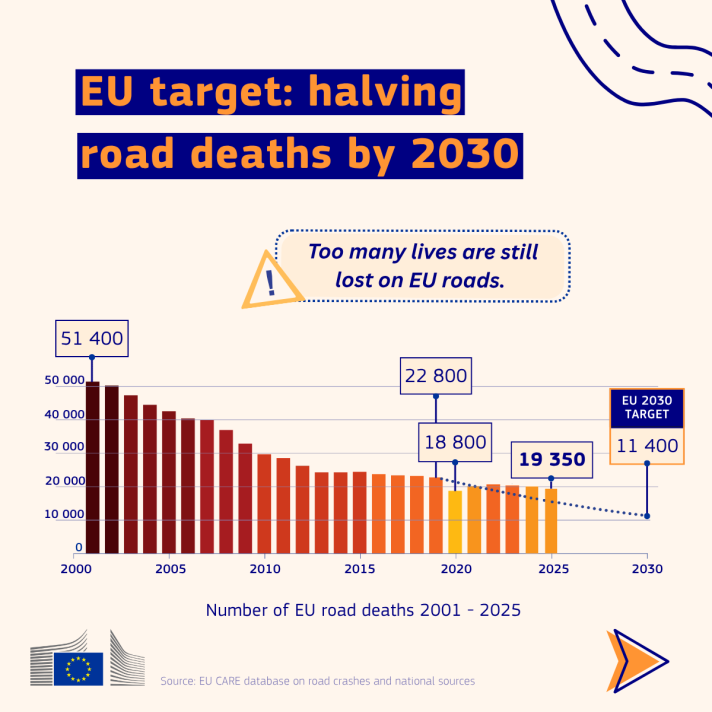
On 27 October 2026, the European Commission released the
final figures on road fatalities for 2025, reporting 19,350 deaths resulting
from road crashes across the EU. This represents a 3% decrease compared with
2024 and a 15% decrease compared with 2019 – an encouraging development towards
the EU target of halving road deaths and serious injuries by 2030 and the
longer-term ambition of Vision Zero: eliminating road deaths and serious
injuries on European roads by 2050.
Source EU CARE Database on Road crashes and national sources (originally published here)
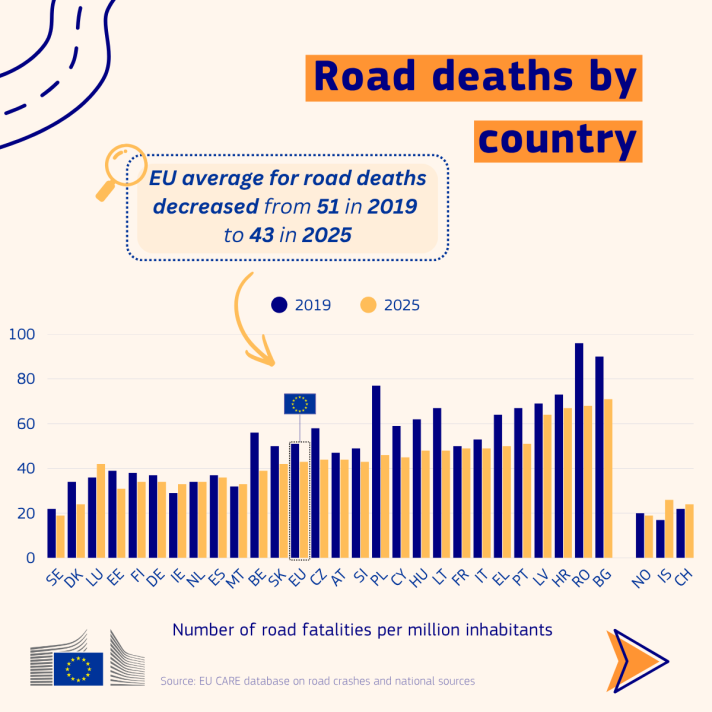
However, progress varies across EU Member States, and most countries are not yet on track to meet the 2030 target. According to the Commission, only five Member States – Belgium, Bulgaria, Denmark, Poland and Romania – are currently on course to achieve a 50% reduction in road fatalities by 2030. At the same time, Bulgaria, Romania and Croatia continue to record the highest fatality rates in the EU, measured by deaths per million inhabitants. Furthermore, for every road fatality, an estimated five people are seriously injured. This means that around 100,000 people across the EU suffer serious injuries in road crashes every year, with lasting physical, psychological and socioeconomic consequences for them and their families.
Vulnerable road users (VRUs) remain particularly exposed to road risks. The latest European figures indicate that older people are more frequently victims of road crashes than other age groups, while passenger car occupants and vulnerable road users – including pedestrians, cyclists and powered two-wheeler users – account for a substantial share of road casualties. Most road deaths also continue to occur on rural roads outside urban areas.
Source EU CARE Database on Road crashes and national sources (originally published here)
The 2026 trend
Provisional data for the first half of 2026 offers an encouraging, though still tentative, signal. The number of countries reporting a reduction in road fatalities of more than 5% compared with the same period in 2025 is higher than the number reporting an increase in deaths. These figures should nevertheless be interpreted with caution: they are provisional, may fluctuate significantly in countries with relatively small numbers of fatalities, and do not yet account for seasonal variations in road crashes.
How are the countries where EvoRoads is tested performing? An overview of 2025 and 2024 data
The latest figures provide an opportunity to look more closely at road safety trends in the four countries where EvoRoads activities and pilots are taking place: Italy, Latvia, Romania and Spain. The following overview combines the latest 2025 fatality figures with the more detailed 2024 statistics available in the European Road Safety Observatory’s country profiles.
Italy
The more detailed 2024 data shows that Italy recorded 3,030 road deaths and 16,735 serious injuries. Its mortality rate was slightly higher than the EU average, placing the country 19th among the 27 Member States in the ranking by fatalities per million inhabitants. Italy also had a higher proportion of fatalities involving powered two-wheelers than the EU as a whole, particularly in urban areas. In 2024, powered two-wheeler users accounted for 29% of road fatalities, compared with 21% across the EU.
Regarding road types, the majority of fatalities in Italy occurred on rural roads (49%). However, the share of fatalities on urban roads was also relatively high, at 43%, compared with the EU average of 38%. The proportion of powered two-wheeler fatalities within urban areas was particularly higher than the EU average. Over the 2014–2024 period, fatalities decreased across all road types, although the overall reduction was smaller than that recorded across the EU.
Latvia
Latvia reported 118 road fatalities in 2025, equivalent to 64 deaths per million inhabitants – one of the highest rates in the EU. Unlike the overall European trend, fatalities increased by 5% compared with 2024. Nevertheless, the longer-term picture shows an 11% reduction compared with 2019.
In 2024, 112 people were killed and 306 people were seriously injured in road crashes in Latvia. The country recorded the fifth-highest mortality rate in the EU that year, with 60 fatalities per million inhabitants, compared with an EU average of 44. The country profile also highlights a significantly higher proportion of pedestrian fatalities and fatalities on urban roads than the EU average. Pedestrians accounted for 30% of road deaths in Latvia in 2024, compared with 18% across the EU.
Latvia has no officially designated motorways, and half of its road fatalities in 2024 occurred on rural roads. The distribution of fatalities within urban areas was similar to the EU pattern. Despite the challenges reflected in the latest figures, Latvia achieved a substantial reduction in road fatalities between 2014 and 2024, with deaths falling by 47% – a greater decrease than the EU average.
Romania
Romania recorded 1,296 road fatalities in 2025, corresponding to 68 deaths per million inhabitants, the second-highest fatality rate in the EU, after Bulgaria. Despite this high rate, the country achieved a substantial improvement: fatalities decreased by 12% compared with 2024 and by 30% compared with 2019. Romania is also among the five EU Member States currently on course to meet the target of halving road fatalities by 2030.
In 2024, Romania recorded 1,478 road deaths and 3,259 serious injuries, with the highest traffic mortality rate in the EU at 78 fatalities per million inhabitants. The country profile highlights a relatively high proportion of pedestrian fatalities and a particularly high share of deaths on urban roads.
In fact, urban roads accounted for the majority of road fatalities in Romania in 2024 (64%), with pedestrians representing a significant share of those killed in urban areas. By contrast, motorways accounted for a relatively small proportion of fatalities (3%). Over the 2014–2024 period, the number of fatalities decreased across road types, with motorways being the exception. These figures underline the importance of addressing road safety risks in urban environments while continuing to improve safety across the wider road network.
Spain
Romania recorded 1,296 road fatalities in 2025, corresponding to 68 deaths per million inhabitants, the second-highest fatality rate in the EU, after Bulgaria. Despite this high rate, the country achieved a substantial improvement: fatalities decreased by 12% compared with 2024 and by 30% compared with 2019. Romania is also among the five EU Member States currently on course to meet the target of halving road fatalities by 2030.
In 2024, Romania recorded 1,478 road deaths and 3,259 serious injuries, with the highest traffic mortality rate in the EU at 78 fatalities per million inhabitants. The country profile highlights a relatively high proportion of pedestrian fatalities and a particularly high share of deaths on urban roads.
In fact, urban roads accounted for the majority of road fatalities in Romania in 2024 (64%), with pedestrians representing a significant share of those killed in urban areas. By contrast, motorways accounted for a relatively small proportion of fatalities (3%). Over the 2014–2024 period, the number of fatalities decreased across road types, with motorways being the exception. These figures underline the importance of addressing road safety risks in urban environments while continuing to improve safety across the wider road network.
Sources:
- European Commission (2026). Road safety statistics for 2025 confirm drop in EU road deaths, 27 October 2026. Read the announcement.
- European Commission (2026). Annual Statistical Report on Road Safety in the EU 2026. European Road Safety Observatory. Read the report (PDF).
- European Commission (2026). Country Profile: Italy. Read the country profile (PDF).
- European Commission (2026). Country Profile: Latvia. Read the country profile (PDF).
- European Commission (2026). Country Profile: Romania. Read the country profile (PDF).
- European Commission (2026). Country Profile: Spain. Read the country profile (PDF).